

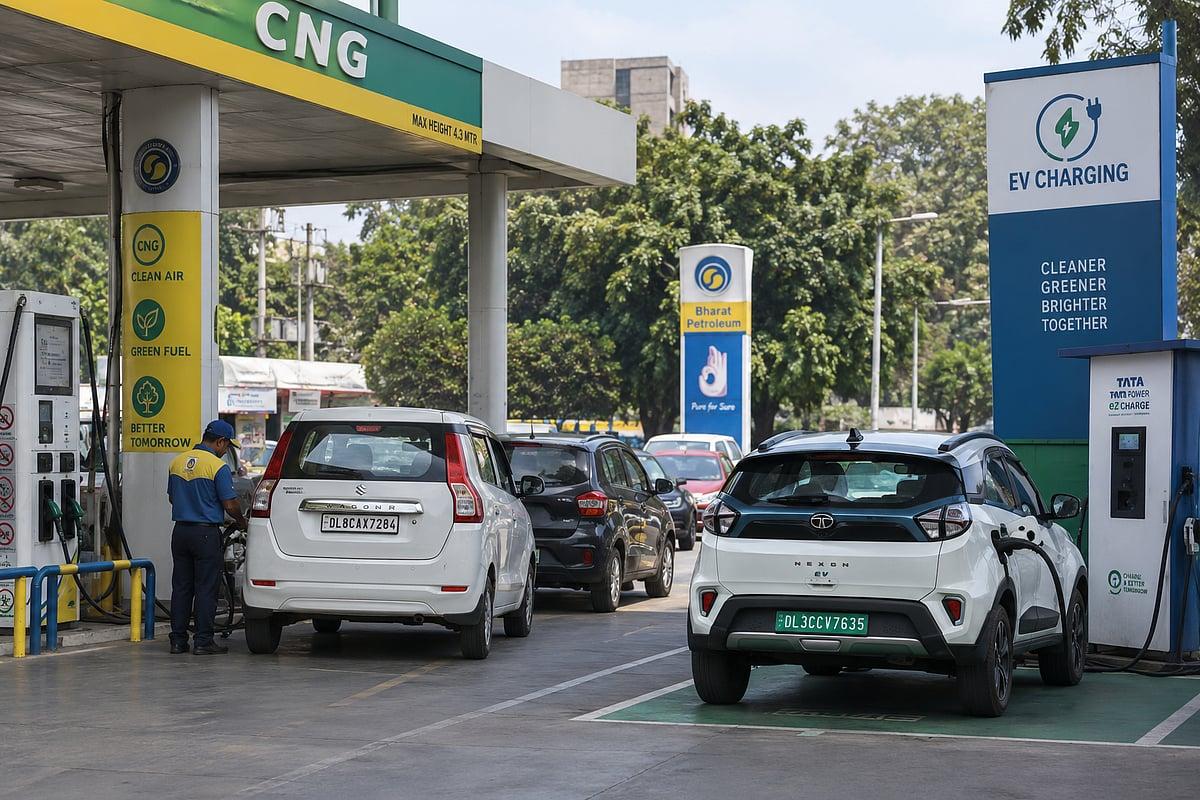
Electric vehicles promise significantly lower running expenses, while petrol cars offer established infrastructure and familiar convenience. ReviewStreet examines the five-year financial implications of both choices for Indian households.
The decision to purchase a new car in India is becoming increasingly complicated.
Until recently, many buyers primarily compared petrol and diesel models. Today, electric vehicles have become an important alternative, particularly for urban commuters.
Electric cars promise lower energy expenses, quieter operation and freedom from tailpipe emissions. Petrol vehicles continue to offer comparatively convenient long-distance mobility, rapid refuelling and a well-established service network.
But which option makes greater financial sense?
The answer depends on several variables: purchase price, annual mileage, electricity tariffs, petrol prices, charging arrangements, maintenance expenses and depreciation.
Instead of focusing only on the showroom price, prospective buyers should examine the total cost of ownership.
What Is Total Cost of Ownership?
Total cost of ownership, or TCO, represents the complete financial cost of owning and operating a vehicle over a specified period.
It includes the initial purchase price, financing expenses, fuel or electricity, servicing, insurance, repairs and eventual resale value.
A vehicle with a lower purchase price may have higher lifetime operating expenses.
Similarly, an expensive vehicle with low running costs may still be a poor financial choice if it is driven infrequently.
For Indian consumers, a five-year comparison provides a practical starting point.
1. Purchase Price: Petrol Cars Often Retain an Advantage
In several popular vehicle segments, petrol cars remain available at lower initial prices than comparable electric alternatives.
Battery packs contribute substantially to the manufacturing cost of EVs, although production technology and market competition continue to evolve.
Buyers should compare vehicles of similar size, equipment level, safety features and passenger capacity.
A basic petrol hatchback should not be compared directly with a premium electric SUV.
Consumers should obtain complete on-road quotations, including taxes, insurance and dealer charges.
Applicable incentives and discounts should be checked individually because schemes vary by vehicle category, location and purchase date.
2. Running Costs: Where Electric Cars Can Win
Electric vehicles typically have lower energy costs per kilometre when charged at affordable residential electricity rates.
Consider this illustrative example.
Assume:
- Petrol price: ₹100 per litre.
- Petrol vehicle efficiency: 16 kilometres per litre.
- Electric vehicle energy consumption: 0.15 kWh per kilometre.
- Residential electricity cost: ₹8 per kWh.
Under these assumptions, the petrol vehicle costs approximately ₹6.25 per kilometre in fuel.
The electric car costs approximately ₹1.20 per kilometre in electricity.
The difference is ₹5.05 per kilometre.
For an owner travelling 15,000 kilometres annually, estimated energy expenditure becomes:
| Expense | Petrol car | Electric car |
|---|---|---|
| Annual distance | 15,000 km | 15,000 km |
| Energy cost/km | ₹6.25 | ₹1.20 |
| Annual energy cost | ₹93,750 | ₹18,000 |
| Five-year energy cost | ₹4,68,750 | ₹90,000 |
The electric vehicle produces an illustrative five-year energy saving of ₹3,78,750.
These calculations are examples, not current fuel-price quotations or measured figures for specific vehicles. They exclude separately billed charging fees and other ownership expenses.
3. What Happens When Annual Mileage Is Low?
Higher mileage generally strengthens the financial argument for electric vehicles.
However, households driving relatively short distances may experience a different result.
At 5,000 kilometres annually, the same assumptions produce yearly energy expenses of ₹31,250 for petrol and ₹6,000 for electricity.
That gives an annual saving of ₹25,250.
Over five years, total energy savings would be approximately ₹1,26,250.
If the electric vehicle costs ₹3 lakh more at purchase, energy savings alone would not recover the difference during this period.
Consequently, an EV should not automatically be described as cheaper for every household.
4. Calculating the Break-Even Point
Suppose a comparable petrol vehicle has an on-road price of ₹9 lakh and the electric version costs ₹12 lakh.
The initial difference is ₹3 lakh.
Using the illustrative energy saving of ₹5.05 per kilometre:
Energy-only break-even distance = ₹3,00,000 ÷ ₹5.05 = approximately 59,400 kilometres.
At 15,000 kilometres annually, the vehicle would reach this distance in roughly four years.
But this is not the complete financial break-even point.
Financing interest, insurance, service costs, charging installation and depreciation can alter the result substantially.
Buyers should therefore treat such calculations as planning tools rather than guaranteed savings.
5. Maintenance Expenses: A Potential EV Advantage
Petrol engines rely on many mechanical and combustion-related components.
Periodic servicing may involve engine oil, filters, spark plugs and related systems.
Battery-electric vehicles eliminate several of these requirements.
Regenerative braking can also reduce dependence on conventional friction brakes during appropriate driving conditions.
Nevertheless, EVs still require maintenance.
Tyres, suspension systems, brakes, air-conditioning, steering and electrical components require inspection.
Repairs outside warranty may be expensive in either vehicle category.
The most reliable comparison uses the service schedules and written maintenance estimates for the exact models being considered.
6. Battery Warranty and Replacement Concerns
Battery durability remains an important consideration for prospective EV owners.
Modern automotive batteries are designed for extended use, but gradual degradation is normal.
Battery health may be influenced by charging patterns, temperature, vehicle usage and thermal-management design.
Consumers should read warranty documents carefully.
Important questions include the covered period, kilometre limit, minimum battery-capacity conditions, exclusions and transferability.
The availability of authorised battery diagnostics is also relevant.
A battery with reduced capacity does not necessarily need immediate replacement, but declining capacity can reduce usable driving range.
7. Home Charging: A Major Convenience Factor
Access to dependable home charging can considerably improve the ownership experience.
Owners may charge overnight without visiting a commercial station.
However, installation requirements depend on electrical infrastructure and housing arrangements.
Apartment residents may need permission from their residential society or building management.
Electrical capacity, earthing, protective equipment and professional installation should be assessed before setting up a charging system.
Consumers should not use unsafe improvised arrangements.
Home charging economics also depend on the applicable electricity tariff.
8. Public Charging Infrastructure in India
India’s EV charging ecosystem is expanding, but charging access remains uneven across locations and routes.
Infrastructure providers are investing in equipment, networks and services.
For example, SMEStreet’s report on Servotech Renewable Power System discusses the company’s EV charging activities and its stated plans for infrastructure expansion.
Such industry investment is relevant to India’s electric-mobility transition.
However, a manufacturer’s expansion plans do not guarantee charger availability in a particular neighbourhood.
Buyers should verify operational public charging locations near their homes, workplaces and commonly travelled highways.
9. Public Charging May Reduce Cost Savings
Commercial charging can be more expensive than residential electricity.
Operators may charge different rates based on energy consumption, service fees, parking or charger type.
If effective charging expense rises to ₹18 per kWh, our illustrative electric car would cost ₹2.70 per kilometre.
That is still lower than the assumed petrol cost, but the financial advantage is smaller.
Drivers who cannot charge at home should calculate their expenses using actual local commercial tariffs.
10. Long-Distance Travel: Petrol Remains Convenient
Petrol cars benefit from an extensive refuelling network.
A fuel stop is generally quick and familiar.
Electric-car owners need to plan around charging availability, connector compatibility, charging speed and battery range.
Highway speeds, hills, traffic, air-conditioning and passenger loads can affect real-world energy consumption.
The certified driving range should not be treated as a guaranteed range in every condition.
For frequent intercity travel through areas with limited charging facilities, petrol vehicles may remain more practical.
11. Charging Time Matters
Electric charging time varies according to battery capacity, charger output, battery state of charge and vehicle limitations.
A charger advertised with high power does not guarantee that every vehicle can accept that power continuously.
Charging speed may decline as the battery approaches a high state of charge.
Buyers should examine actual charging curves and supported charging standards.
People who regularly make long-distance journeys should evaluate realistic stopping times rather than relying on ideal laboratory figures.
12. Resale Value and Depreciation
Resale value is one of the least predictable factors in a five-year vehicle comparison.
Petrol cars benefit from a mature used-car market.
Electric-vehicle resale prices can be influenced by battery health, remaining warranty, charging technology and the availability of newer models.
Rapid improvements in range or charging speed may affect demand for older vehicles.
On the other hand, buyers may value an EV with strong battery health and documented service history.
Consumers should obtain current resale quotations for comparable models rather than relying on assumed depreciation percentages.
13. Environmental Considerations
Electric cars produce no tailpipe emissions during operation.
This can provide local air-quality benefits, especially in congested urban areas.
However, the complete environmental picture includes battery manufacturing, electricity generation, material sourcing and recycling.
Electric vehicles become more environmentally attractive when powered through cleaner energy sources.
India’s renewable-energy development is therefore relevant to its automobile transition.
A wider SMEStreet industry outlook examining renewable energy, storage and electric mobility discusses how clean-energy infrastructure and automotive developments are interconnected.
For consumers, this demonstrates why vehicle electrification should be considered alongside energy-system development rather than in isolation.
14. Which Vehicle Is Better for Different Buyers?
Daily urban commuters
An EV may make financial sense when annual mileage is high and home charging is available.
Families with low annual mileage
A petrol vehicle may offer better overall value when the EV purchase-price premium is difficult to recover.
Frequent highway travellers
Petrol vehicles may offer greater convenience where charging infrastructure remains inadequate.
Environmentally conscious consumers
An EV may help reduce local tailpipe pollution, although lifecycle emissions should also be considered.
Apartment residents
Charging feasibility should be confirmed before purchasing an electric vehicle.
Frequently Asked Questions
Are electric cars cheaper to run than petrol cars?
They often have lower energy costs per kilometre, particularly when charged using reasonably priced home electricity.
How long does it take to recover an EV’s higher purchase price?
It depends on the initial price difference, annual mileage, energy tariffs and other ownership expenses.
Do EVs require regular servicing?
Yes. Although they have fewer engine-related service requirements, tyres, brakes, suspension and other components still need maintenance.
Is public charging expensive?
Rates differ between operators. Commercial charging may cost significantly more than home charging.
Are electric cars practical for long trips?
They can be, provided suitable charging infrastructure is available along the route.
What is the biggest financial risk when buying an EV?
Potentially important uncertainties include depreciation, battery-related repair exposure and charging expenses.
ReviewStreet Verdict
For urban commuters covering substantial annual distances with reliable home charging, electric cars can provide attractive long-term savings.
For households that travel relatively little or lack dependable charging arrangements, petrol vehicles may still offer a more practical financial choice.
The right decision is not simply electric versus petrol. It is about selecting the vehicle with the lowest realistic total ownership cost for your individual driving pattern.
ReviewStreet Auto Desk
Editorial note: All calculations are illustrative. Actual vehicle prices, tariffs, incentives and resale values should be verified before purchasing.